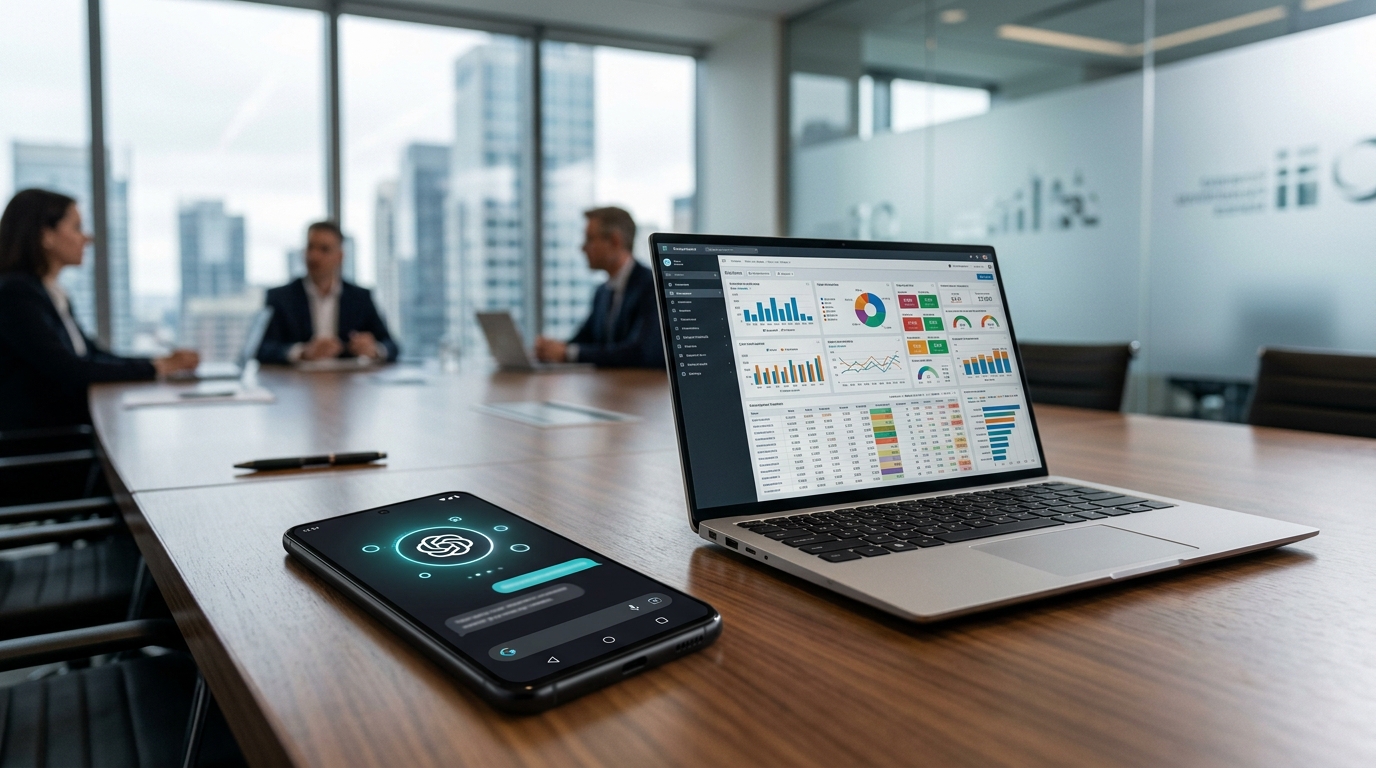
In seven days, Apple will stand on stage and demonstrate what AI looks like when it runs natively on a billion devices. Not a web app. Not a third-party integration. Built into the OS, tied to Siri, running on-device in ways that feel fast and personal and immediate.
Every employee in your organization has an iPhone or a Mac. Most of them are going to watch that keynote — or watch the clips — and think: why does the AI on my phone do that, but the AI at work can’t?
That’s the question your enterprise strategy needs to answer before June 8. Not after.
The Expectation Gap Is About to Get Visible
For the past two years, the gap between consumer AI and enterprise AI has been abstract. Employees knew ChatGPT existed. Some used it personally. Most didn’t think about it in the context of their daily work tools.
WWDC changes that. Apple Intelligence isn’t a chatbot they have to seek out — it’s an OS-level feature that rewrites emails, summarizes notifications, and integrates with apps they already use. The experience is contextual and immediate.
When that’s running on their phone, and their enterprise tools are still requiring 15 steps to generate a report, the gap isn’t abstract anymore. It’s sitting in their pocket at every meeting.
What This Means for Enterprise AI Decision-Makers
The pressure this creates is real, but it can push decisions in the wrong direction. The wrong response is a reactive sprint to “add AI” to existing systems in ways that don’t address the actual problem.
The actual problem isn’t that your enterprise stack lacks AI features. It’s that employee workflows have friction that AI could remove — and nobody has mapped where that friction actually is.
Apple Intelligence is compelling because it removes friction at the OS level. The consumer experience wins because it’s embedded in things people already do. Enterprise AI wins the same way: embedded in actual workflows, not bolted on as a separate tool.
The right pre-WWDC question isn’t “what AI features should we announce?” It’s “what are the three highest-friction workflows our employees deal with daily, and what would it take to reduce them?”
The Three Things to Have Ready Before June 8
An honest inventory of your current AI footprint. What have you actually deployed? What’s being used vs. what’s technically available? If you can’t answer that quickly, someone at your organization is about to ask, and “we have several initiatives underway” isn’t the answer the board wants.
A clear position on Apple Intelligence in your stack. Apple will offer enterprise APIs. Your BYOD and MDM policies will have opinions about on-device AI features. IT and security need to have a position on this before employees ask why their personal phone features don’t work in company apps. Get ahead of that conversation.
A roadmap with a friction-reduction frame. Not “here’s our AI strategy” as a list of tools and vendors. Here’s the specific workflow problems we’re solving, the metrics we’re using to know when they’re solved, and the timeline. That framing survives WWDC. A vendor list doesn’t.
The Opportunity in the Pressure
The WWDC news cycle is going to generate pressure for AI announcements across enterprise organizations. Some of that pressure will produce bad decisions. But it also creates a genuine opening for technology leaders who are already prepared.
If you have a coherent strategy with measurable outcomes, the WWDC conversation becomes easy: “Yes, we’ve been tracking this. Here’s what we’re doing, here’s what we’re not doing, and here’s why.” That’s the answer that builds credibility with the board.
If you’re building that strategy reactively — if you’re reading think pieces on June 9 and trying to figure out what to do — you’ve already lost the timing advantage.
Seven days is enough time to get positioned. Use them.
VitaLink Software helps enterprises build AI systems designed around real workflow problems — not around announcements. Start here if you want to get positioned before the week gets away from you.