
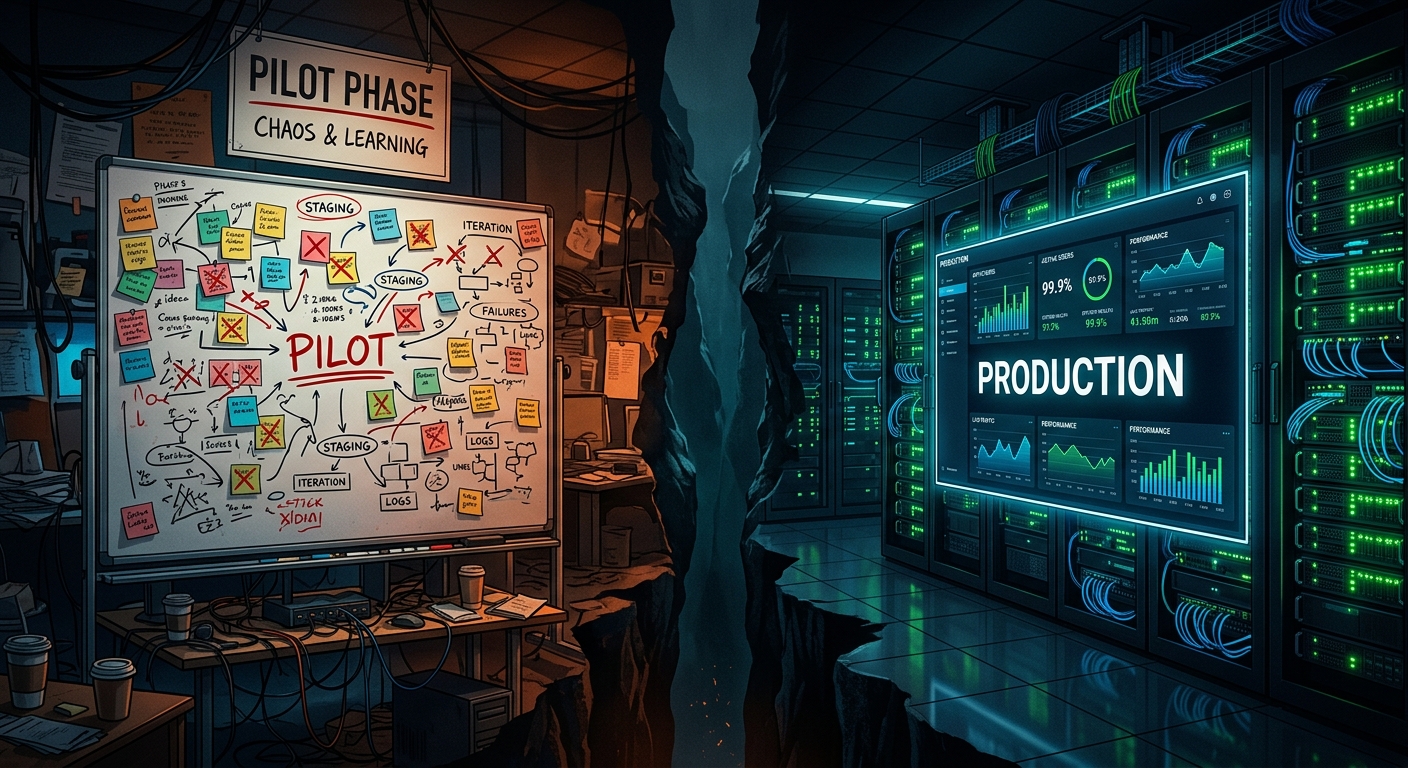
The pilot worked. The demo was impressive. Leadership signed off. And then, somewhere between “this is promising” and “this is in production,” it died.
This is the most common arc in enterprise AI right now. MIT’s GenAI Divide report puts it plainly: 95% of generative AI pilots fail to move beyond the experimental phase. Not because the technology didn’t work. Because everything around the technology wasn’t ready to support it.
What Pilots Are Actually Testing
A pilot, by design, optimizes for a narrow question: does this AI do the thing we think it can do? That’s a reasonable question. It’s just not the same question as: can this AI do that thing, at scale, reliably, integrated into our systems, with governance in place, in a way people will actually use?
When you run a pilot without asking the second question, you’re collecting the wrong data. You learn that the model performs. You don’t learn whether your data pipelines can support it, whether your team will change how they work around it, or whether your existing architecture can absorb it without cracking.
That’s not pilot failure. That’s pilot scope creep masquerading as production readiness.
The Three Gaps That Kill Pilots
1. The data gap. Pilots usually run on clean, curated, ready-to-go data — because the point is to show what the AI can do. Production runs on messy, inconsistent, live data — because that’s what your business actually generates. The model that worked beautifully in the demo often meets real data and immediately degrades. Not a model problem. A data infrastructure problem that the pilot was never designed to surface.
2. The integration gap. A pilot output that goes nowhere is fine for a demo. In production, outputs have to flow into existing systems: CRMs, ticketing tools, ERPs, decision workflows. Building those integrations is a different class of engineering problem than building the AI layer. Teams that skip integration design until after the pilot wins approval are starting an expensive rebuild from scratch.
3. The adoption gap. This one is the quietest killer. The system ships, it works, and no one changes how they operate. The AI sits unused at the edge of a workflow instead of reshaping it. KPMG’s enterprise AI maturity research flags governance and change management — not technical capability — as the primary reason pilots stall. The technology is ready. The organization isn’t.
What the 5% Did Differently
They didn’t run better pilots. They ran pilots designed to answer production questions.
Before writing a single line of code, they mapped the decision the AI was meant to improve — and traced that decision back through the organization: where does the data live, who makes the call, where does the output need to land, and who has to change behavior to make it work?
That map becomes the integration design. The pilot becomes a test of the integration assumptions, not just the model performance. And by the time a demo is ready to show leadership, the production architecture is already sketched out.
It’s a slower start. It almost always ships.
The Question Worth Asking Before Your Next Pilot
If this pilot succeeds, what has to be true for it to reach production?
List those things out. If you can’t answer them, or the answers reveal gaps you haven’t addressed, you’re building a great demo — not a production system.
That’s the work we do at VitaLinkSoftware. Not the pilot. The path from pilot to production.