
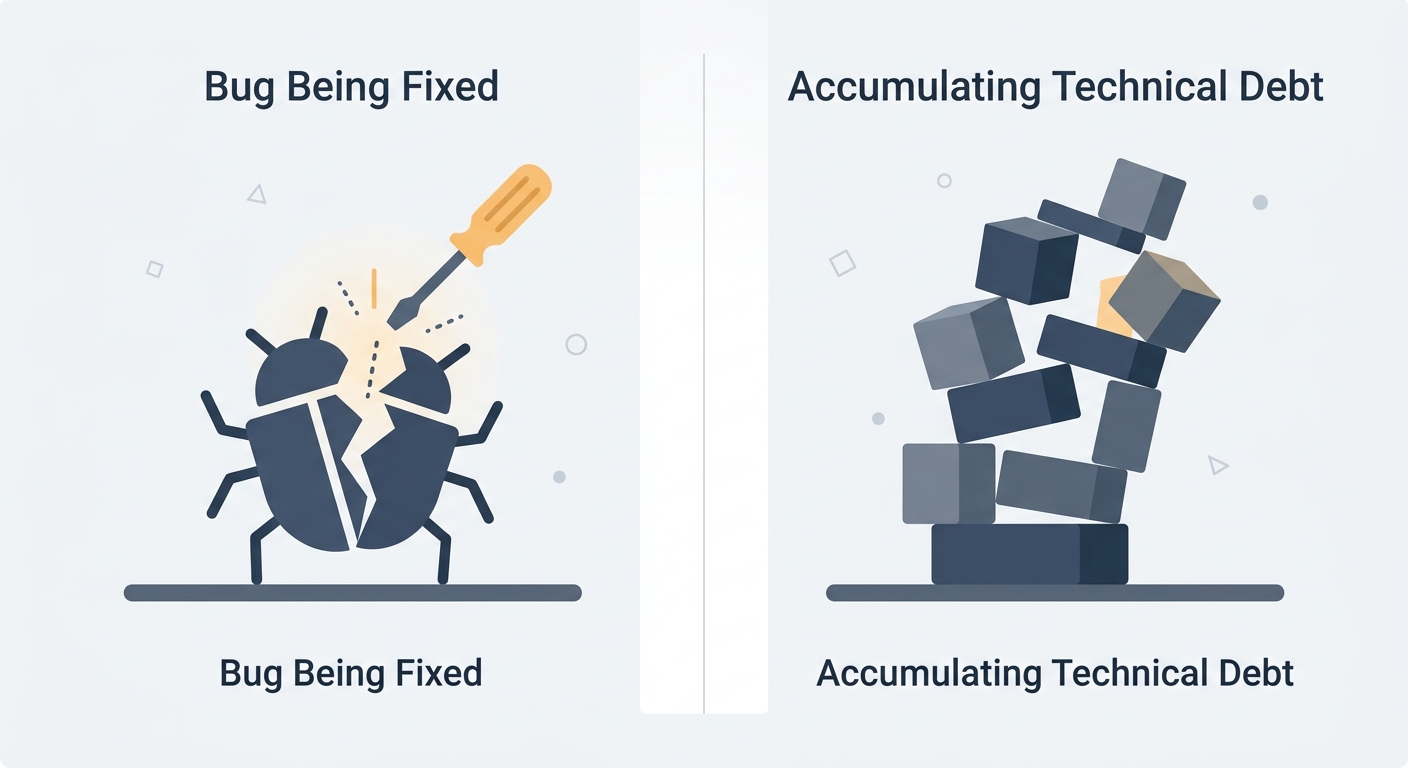
Open most engineering backlogs and you’ll find bugs and technical debt sitting in the same list, competing for the same sprint slots, evaluated by the same triage process. That’s the root of why technical debt so reliably loses. It’s not that teams don’t understand debt matters — it’s that the system they use to prioritize work treats a fundamentally different category of problem as if it were the same thing, and the thing it resembles more (a bug) always wins that comparison.
What a Bug Actually Is
A bug is a gap between what the system is supposed to do and what it actually does. It’s binary and it’s provable: either the checkout flow processes the payment correctly or it doesn’t, either the report generates the right numbers or it doesn’t. A bug has a clear before-and-after state, a clear owner of “this is wrong,” and — critically — a clear moment where it started being true. Something changed, and now behavior doesn’t match spec.
What Technical Debt Actually Is
Technical debt is different in a way that matters more than most backlogs acknowledge: the system is working exactly as designed. Nothing is broken. What’s true instead is that the design itself is going to cost more over time than a better design would have — in maintenance effort, in onboarding time for new engineers, in the compounding difficulty of making the next change safely. Technical debt doesn’t have a moment where it started being wrong, because it was never wrong. It’s a design decision whose cost structure gets worse the longer it goes unaddressed.
Why Conflating Them Actually Costs You
Bugs win the triage comparison every time, structurally. A bug has a demonstrable current failure. Technical debt has a probabilistic future cost. When the same process has to rank both, “definitely broken right now” beats “will probably cost more later” almost automatically, regardless of the actual magnitude of either problem. This isn’t a discipline failure on the team’s part — it’s what happens when you force two different kinds of problems through one evaluation lens built for one of them.
Technical debt items don’t get better arguments over time. They get worse ones. A bug ticket gets written once, with clear reproduction steps, and it’s done — it either gets fixed or it doesn’t. A technical debt item sits in the backlog getting re-justified every planning cycle, competing against fresh bugs with fresh urgency each time, and the argument for it never sharpens. It just keeps losing the same comparison, indefinitely, until the cost it was warning about eventually shows up as an actual incident — at which point it’s reclassified as an emergency bug and finally gets attention, at a much higher cost than addressing the debt would have.
Debt compounds in a way bugs don’t. An unfixed bug generally stays the same size. Unaddressed technical debt tends to grow, because every new feature built on top of a flawed design inherits that flaw, and the cost of eventually fixing it grows with everything now depending on the workaround.
The Practical Fix: Separate Budgets, Separate Justifications
Give technical debt its own allocation, not a spot in the general backlog. A fixed percentage of engineering capacity — a day a week, a sprint a quarter, whatever fits your team’s cadence — reserved specifically for debt work that never has to win a head-to-head comparison against a live bug. If debt work only gets funded by winning that comparison, it will lose it, structurally, every time.
Require a different kind of justification for each. A bug ticket needs reproduction steps and impact. A technical debt item needs a cost trajectory: what does this cost today, what will it cost in six months if untouched, and what specifically is getting harder because of it. Forcing that second question is what turns a vague “this code is messy” complaint into an actual prioritizable item instead of something that’s easy to wave off.
Track debt as its own list, visible on its own terms. If technical debt items live buried inside a general backlog, they stay invisible to anyone not already looking for them. A separate, visible list — reviewed on its own cadence, not just competing for slots in sprint planning — is what keeps debt from quietly disappearing every single cycle.
The Bottom Line
Bugs and technical debt aren’t different flavors of the same problem — they’re different categories that require different evaluation criteria, different justifications, and ideally different budgets. Running them through one shared triage process isn’t neutral. It’s a structural bias against the one that doesn’t look urgent yet, until the day it very suddenly does.