
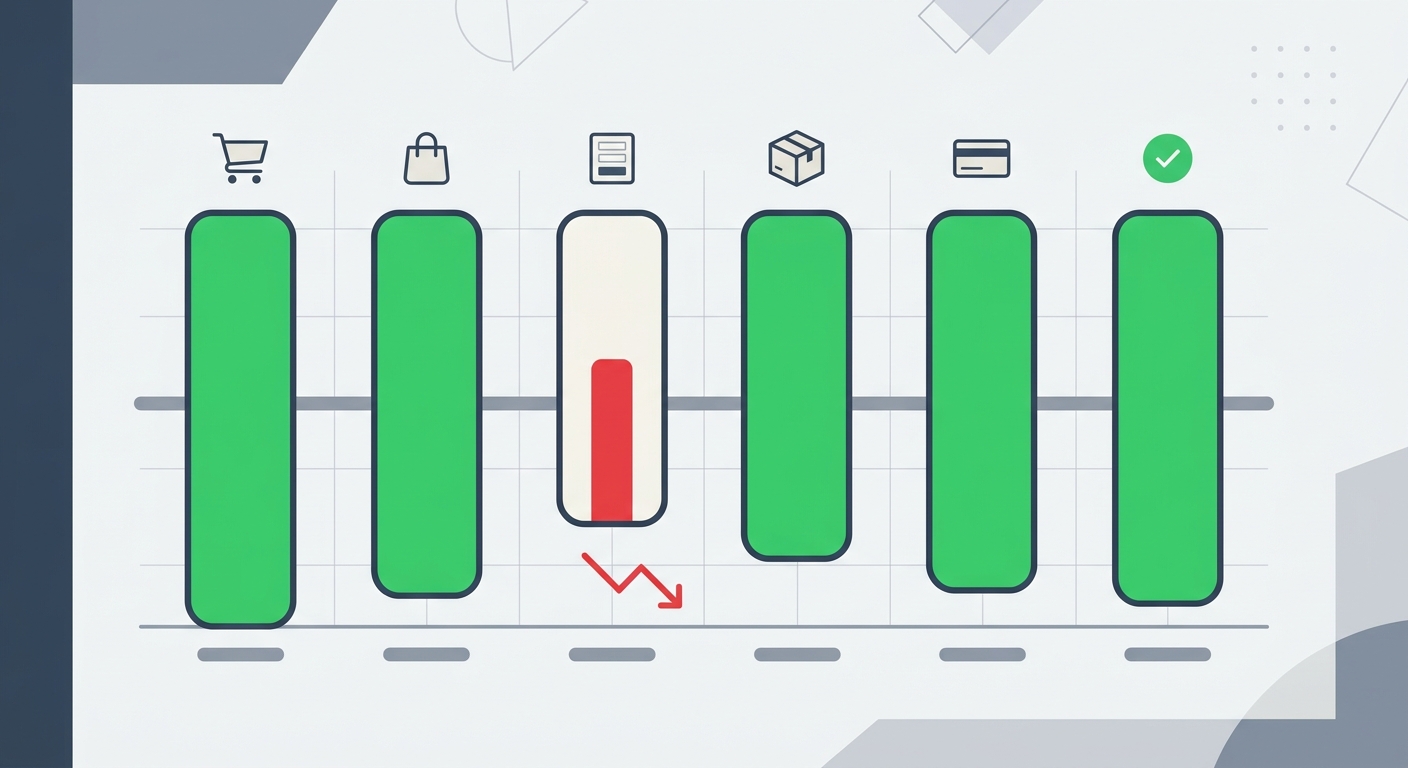
A fast site and a checkout that converts well get treated as roughly the same problem, measured with roughly the same tools. They aren’t the same problem, and conflating them means a genuinely fast site can still be losing customers at checkout in ways a page-speed dashboard will never surface, because speed was never the actual friction there.
Why Speed Metrics Miss the Checkout Problem
Page speed tools measure how fast a page loads and renders. Checkout abandonment is overwhelmingly driven by things that happen after the page has already loaded fine — a form that asks for information in a confusing order, a shipping cost that only appears at the last step, a payment method someone expected to see and didn’t. None of that shows up as a speed problem, because it isn’t one. A checkout can score perfectly on every speed metric and still lose a third of the people who reach it, for reasons a speed audit is structurally incapable of catching.
Where the Real Friction Actually Lives
Cost surprises late in the flow. Shipping, taxes, or fees that only appear at the final step — after someone has already invested the effort of filling out the rest of the form — produce a specific, sharp abandonment spike right at that step. This is one of the most consistently underestimated sources of checkout loss, because it’s invisible until you’re looking at step-by-step drop-off specifically, not aggregate conversion.
Account creation friction at the wrong moment. Requiring an account before completing a purchase, especially for a first-time buyer, introduces a decision point that has nothing to do with the actual purchase. Some of that friction is unavoidable for legitimate reasons. The version that costs conversions is requiring it before showing someone the final price and confirming the purchase is even worth the account.
Form fields that ask for more than the transaction needs. Every additional required field is a small tax on completion, and the tax compounds — a form with twelve required fields loses more people than one with six, even if both eventually collect the same information, because the perceived effort at the start of the form shapes whether someone starts filling it out at all.
Payment options that don’t match how the actual customer wants to pay. A checkout that only supports one payment method, or doesn’t support the one a specific customer segment actually prefers, loses those customers at the exact moment they’d otherwise complete the purchase — and this is invisible in aggregate conversion numbers unless you’re specifically segmenting by what payment options were shown versus used.
How to Actually Find It
Step-by-step funnel analysis, not just an overall conversion rate. An aggregate checkout conversion number tells you the checkout has a problem. It doesn’t tell you where. Breaking the funnel into individual steps and measuring drop-off at each one is the only way to find out whether the loss is concentrated at a specific step — which it usually is — rather than spread evenly across the whole flow.
Session recordings on the checkout specifically, not the whole site. Watching a sample of real checkout attempts, especially abandoned ones, surfaces friction a funnel chart can quantify but not explain — the hesitation before a specific field, the back-and-forth on a shipping option, the moment someone visibly gives up.
A genuine cost-and-fee audit against what’s disclosed, and when. Compare what a customer sees at the start of checkout against what they’re actually charged at the end, and specifically note at which step any new cost first appears. This single check catches one of the most common and most fixable sources of late-stage abandonment.
The Bottom Line
Site speed and checkout conversion get measured with the same instinct and mostly the same tools, but they’re different problems with different failure modes. A fast site is worth having. It’s not a proxy for a checkout that converts, and treating it as one means the actual friction — cost surprises, unnecessary account requirements, bloated forms, missing payment options — stays invisible to the dashboard that’s supposedly tracking performance.