
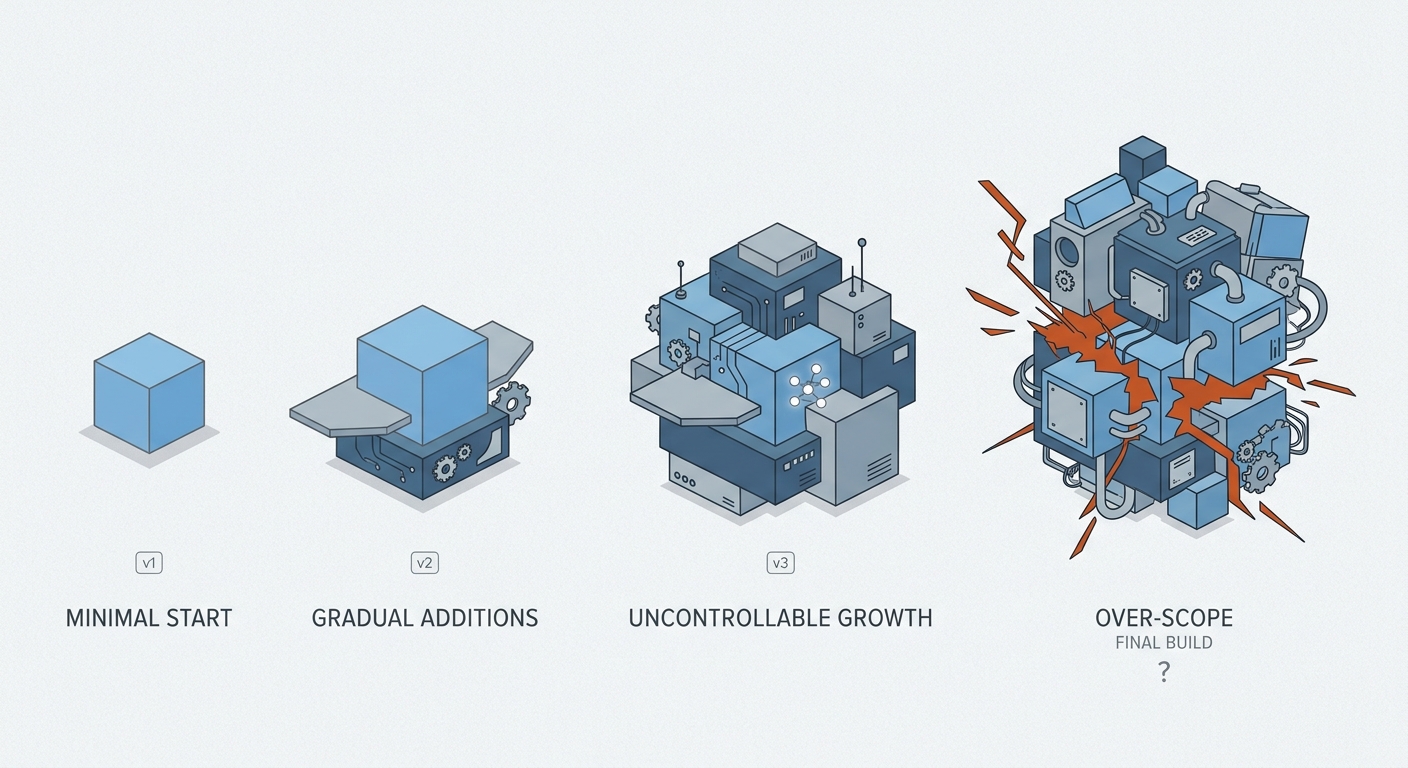
Every MVP starts with a genuinely disciplined scope: the smallest version of the product that actually tests the core hypothesis, nothing more. Most of them don’t stay that way. Somewhere between the kickoff meeting and launch, the “minimal” quietly disappears, and what ships is a much bigger, slower, more expensive build than what anyone agreed to at the start. This happens often enough that it’s worth understanding as a pattern, not a one-off planning failure.
How the Scope Actually Grows
“While we’re in there” additions. A developer working on the core feature notices an adjacent improvement that would be easy to add now and expensive to add later. Individually, each one is a reasonable call. Collectively, a dozen small “while we’re in there” additions add up to a meaningfully bigger build than the one that was scoped, and no single addition felt like the moment scope actually crept.
Stakeholder additions that arrive after the scope is “locked.” Someone reviews an early build, has a genuinely good idea, and asks for it to be included before launch rather than in a follow-up release. Each individual ask is reasonable on its own merits. The problem isn’t any single addition — it’s that there’s rarely a mechanism forcing a real tradeoff conversation (“if this goes in, what comes out, or what does the timeline become”) before it’s just added to the list.
The completeness instinct. A genuine MVP is supposed to be embarrassing to launch — it does the core thing and conspicuously little else. Most teams, even ones who intellectually understand that principle, find it hard to actually ship something that looks unfinished. The instinct to round out rough edges before anyone sees it is natural and, for an MVP specifically, actively counterproductive.
Why This Actually Costs More Than It Looks Like
Time to first real signal. The entire point of an MVP is getting the core hypothesis in front of real users as fast as possible. Every addition that isn’t the core hypothesis delays that moment, which means the actual cost of scope creep isn’t just the extra build time — it’s the extra time before you learn whether any of this was worth building at all.
Sunk cost on the additions themselves. If the core hypothesis turns out to be wrong, the extra features built alongside it were wasted regardless of how good any individual one was. An MVP that ships lean fails cheap. An MVP that quietly became a full build fails expensive, in both time and the team’s appetite to try again.
What Actually Prevents This
Write the exclusion list, not just the scope. Most MVP planning documents describe what’s in. Far fewer explicitly list what’s deliberately out, with the reasoning attached. A written, visible exclusion list gives the team something concrete to point back to when a “while we’re in there” addition shows up mid-build — the question isn’t “is this a good idea,” it’s “did we already decide this was out, and has anything actually changed that reasoning.”
Require a real tradeoff for every addition, not just approval. Nothing gets added to an in-flight MVP for free. If a stakeholder wants something included, the actual question is what gets cut or what the new timeline is — not just whether the addition itself is good. Forcing that tradeoff conversation, every time, is what keeps “sure, let’s add it” from being the default answer.
Separate “rough” from “broken.” An MVP is allowed to look unfinished. It’s not allowed to actually not work. Being explicit about that distinction with the team — rough edges are fine, broken functionality isn’t — gives people permission to resist the completeness instinct without feeling like they’re shipping something embarrassing for the wrong reasons.
Set a hard ship date tied to the hypothesis test, not to feature completeness. A launch date anchored to “when it feels done” has no natural brake on scope. A launch date anchored to “when we can start learning whether the core idea works” does, because every addition has to justify itself against that specific deadline instead of a vague sense of readiness.
The Bottom Line
The MVP trap isn’t usually one bad decision — it’s a dozen individually reasonable ones, none of which felt like the moment scope actually broke. The fix isn’t more discipline in the abstract. It’s specific mechanisms — a written exclusion list, a forced tradeoff for every addition, a ship date tied to the actual hypothesis — that make the discipline something the team can actually act on instead of just intend.